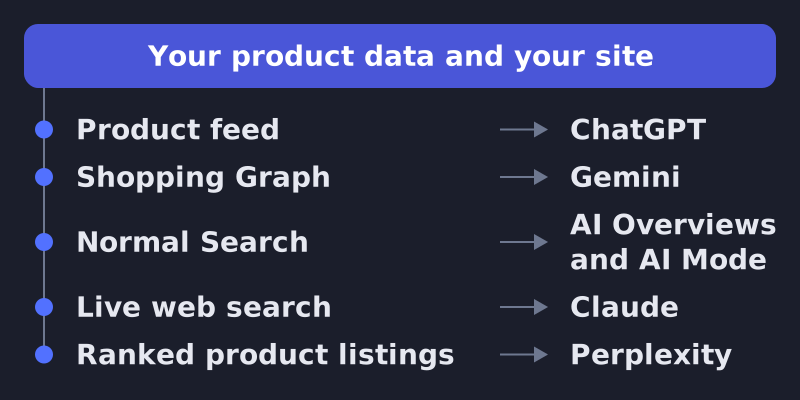
There is no single switch for appearing in AI answers. ChatGPT, Gemini and Perplexity each use shopping data of their own, Claude answers from live web search, and all of them lean on what a store publishes: accurate product data, readable pages and current prices.
What you can do is keep that data clean and complete, everywhere it is read.
This page describes what the platforms' own documents say. The features change quickly, so treat the linked pages as the final word.
What each assistant reads
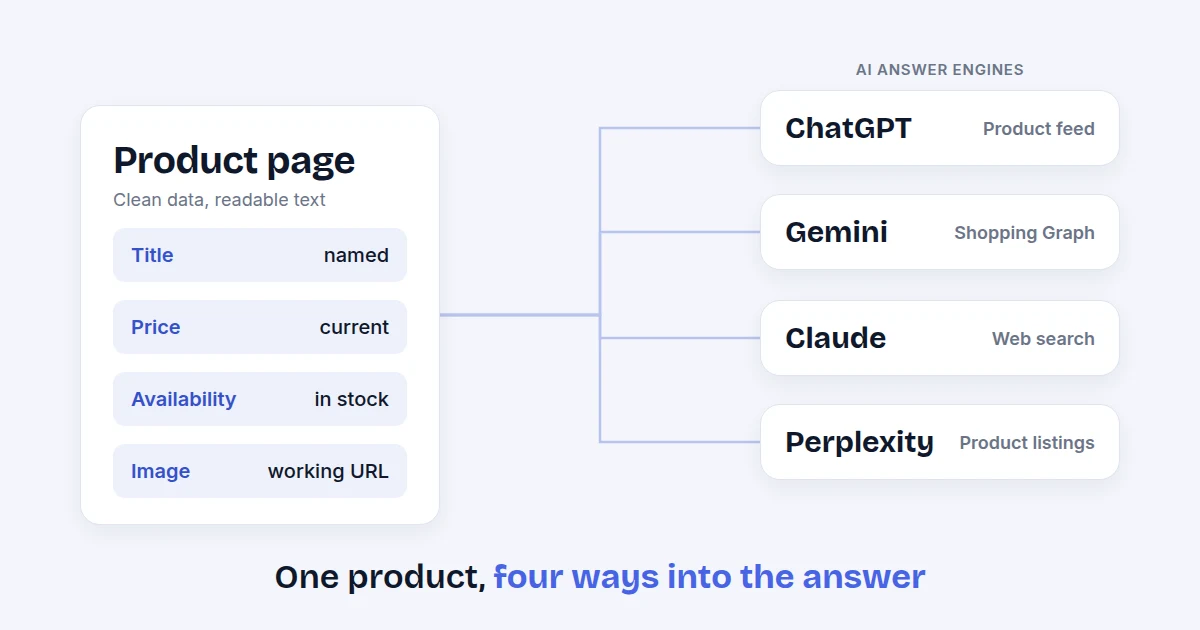
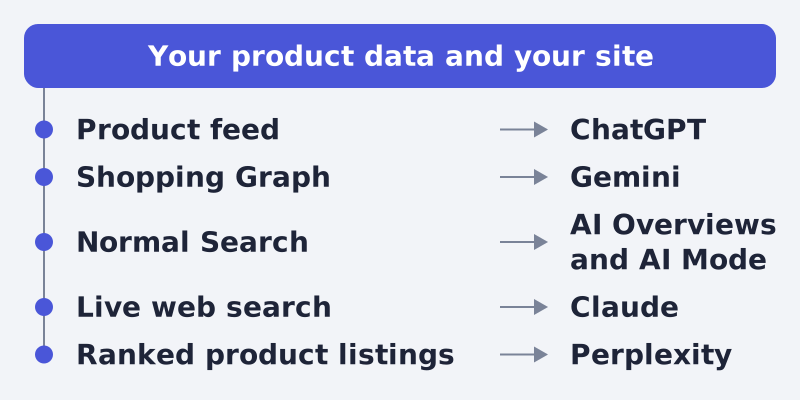
ChatGPT. OpenAI documents a product feed format for ChatGPT shopping: a file with item id, title, description, URL, brand, seller name, image URL, availability and price for each product, delivered over SFTP, with a full snapshot at least once a day (OpenAI: Agentic Commerce, OpenAI: product feed spec). Onboarding feeds is currently limited to approved businesses, who apply through a form on chatgpt.com/merchants (OpenAI: Agentic Commerce). OpenAI's help article, as quoted in search results, says ChatGPT chooses product results itself, apart from ads, and that Shopify merchants are covered through Shopify's catalog without extra work (OpenAI Help Center: Shopping with ChatGPT search). Check the article on OpenAI's site for the current wording.
Gemini. The Gemini app takes product data from Google's Shopping Graph to find items, compare them and support a purchase. It works in the Gemini app on mobile and web and in Gemini in Chrome, for adult personal accounts, in 21 countries and regions, and only for eligible merchants (Gemini Apps Help).
Google AI Overviews and AI Mode. Google says there are no additional requirements to appear in them and no special schema.org markup to add. A page needs to be indexed and eligible to show a snippet in normal Search (Google Search Central: AI features).
Claude. Anthropic describes web search: Claude searches the web when it applies, to give current answers, and cites the sources it used. Web search is available on all Claude plans worldwide since 27 May 2025 (Claude blog: web search). That page describes web search, not a shopping feed.
Perplexity. Perplexity's help center, as quoted in search results, says it ranks product listings with criteria similar to those for sources in normal answers, that listings with availability, reviews, pricing and specifications are likelier to be suggested, and that the order is set by relevance and ratings, not advertising (Perplexity Help Center: Shop like a Pro). Check the page on Perplexity's site for the current wording.
What this means for a store
The roads differ, the raw material is the same. A shopping feed, a product graph and a web search all depend on facts that your own site and feeds state clearly.
1. Clear, complete product data
Titles that name the product, a plain description, brand, a working image URL and the product page URL are the first fields in OpenAI's spec (OpenAI: product feed spec). Prices follow a fixed shape: the amount, a decimal point and an uppercase three-letter currency code, such as 79.99 USD. Availability uses a fixed list: in_stock, out_of_stock, pre_order, backorder or unknown. Unknown optional values are left out, not filled with n/a.
2. Product markup on the page (schema.org Product)
Google's documentation separates two uses of Product structured data. Product snippets suit pages where people cannot buy; merchant listings suit pages where they can, and carry more detail such as shipping and returns (Google: Product structured data). For a merchant listing the required properties are name, image and offers; inside the offer, a price above zero and a price currency in a three-letter code. Availability is recommended. The seller must be the merchant, so one Offer, not an AggregateOffer. JSON-LD is one of the formats the page shows, next to RDFa and Microdata (Google: Merchant listing structured data).
Google also says to keep structured data consistent with the visible text of the page (Google Search Central: AI features). A marked-up price that differs from the price on the page is the kind of mismatch to avoid.
3. Accurate prices and stock
OpenAI's spec says to submit the current price and update the feed when a sale starts or ends, and to update availability as items sell out or return (OpenAI: product feed spec). Google asks you to keep Merchant Center information current (AI features), and recommends considering a Merchant Center feed on top of markup (Product structured data). A wrong price in an assistant's answer is a price that was wrong somewhere in your data.
4. A site that can be read
For AI Overviews and AI Mode Google lists plain basics: do not block crawling in robots.txt or at the CDN or host, link pages to each other, give a good page experience and make important content available as text (Google Search Central: AI features). Claude's and other assistants' web search reach the same public pages, so a product page that works without a script and states the product in words helps there too. That second part is an interpretation, not a quote from those pages.
5. llms.txt, an emerging idea
llms.txt is a proposal by Jeremy Howard from September 2024 for a Markdown file at your site root that gives AI agents a short overview and links to the best pages. It is a proposal, not a finished standard, and the proposal itself does not say any provider reads it for answers (llmstxt.org). Google's guidance says no AI-specific text files are needed to appear in its AI features (AI features). Adding one is cheap and harmless; do not expect it to replace the basics above.
6. Measure what you can
Clicks from AI Overviews and AI Mode are counted in Search Console's Performance report under the Web search type (Google Search Central: AI features). For the other assistants, watch referral traffic in your analytics and check by hand: ask the assistants about your own products and note what they show.
A short checklist
- Every product has a stable ID, a clear title, brand, image and a public URL.
- Price, currency and availability on the page, in the markup and in the feed all agree.
- Product markup is valid and matches what a shopper sees.
- Crawling is allowed, pages are linked and indexed.
- The feed or Merchant Center data is refreshed whenever price or stock changes.
FAQ
Can I pay to appear in ChatGPT's or Perplexity's product results?
Both describe product results as separate from ads: ChatGPT chooses results apart from ads (OpenAI Help Center) and Perplexity says order follows relevance and ratings, not advertising (Perplexity Help Center). Both statements come from excerpts, so confirm them on the platforms' pages.
Do I need special markup for Google's AI features?
No. Google says there is no special schema.org markup to add and no additional requirement beyond being indexed and eligible for a snippet (Google Search Central: AI features). Product markup still helps normal shopping features (Product structured data).
Does llms.txt make assistants recommend my products?
There is no evidence in the proposal or in Google's guidance that it does (llmstxt.org, AI features). Treat it as an optional extra.
Written by
Framepx team, Editorial team
The Framepx editorial team writes for brands, marketers and agencies about ad platforms, measurement, creative and product feeds.