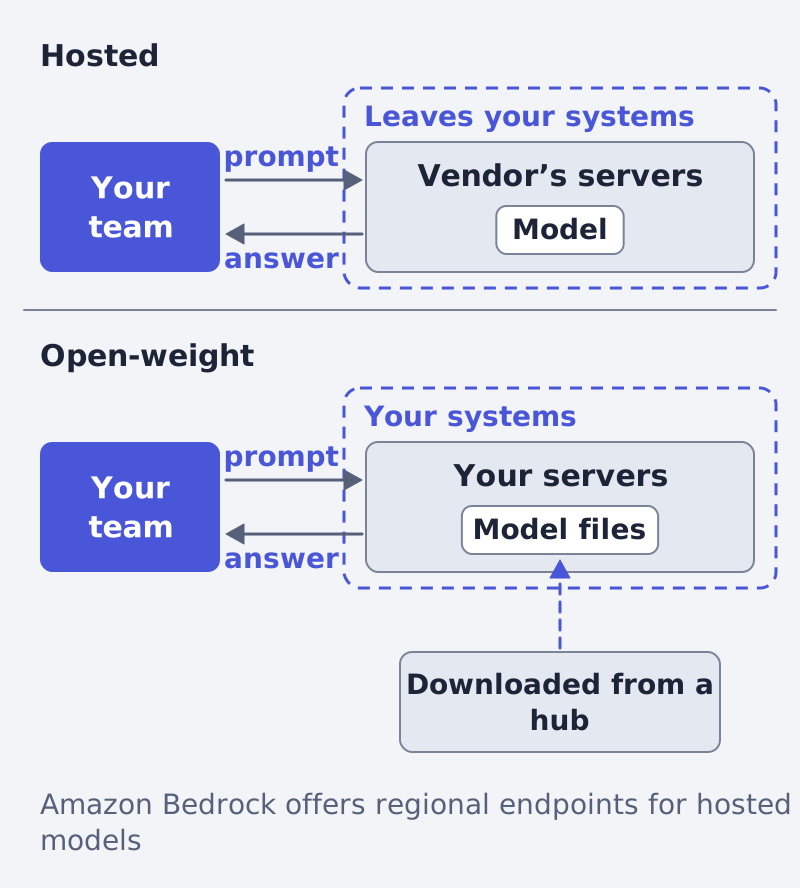
An open-weight model is an AI model whose files you can download and run on your own machines, while a hosted model is one you reach through someone else's API. Open models make sense when data must stay in house, when volume is steady and high, or when one narrow task is worth fine-tuning, and only if you have people to run them.
For the hardest reasoning, or with no technical team, a hosted model is usually the simpler choice (our reading, explained below).
What an open-weight model is
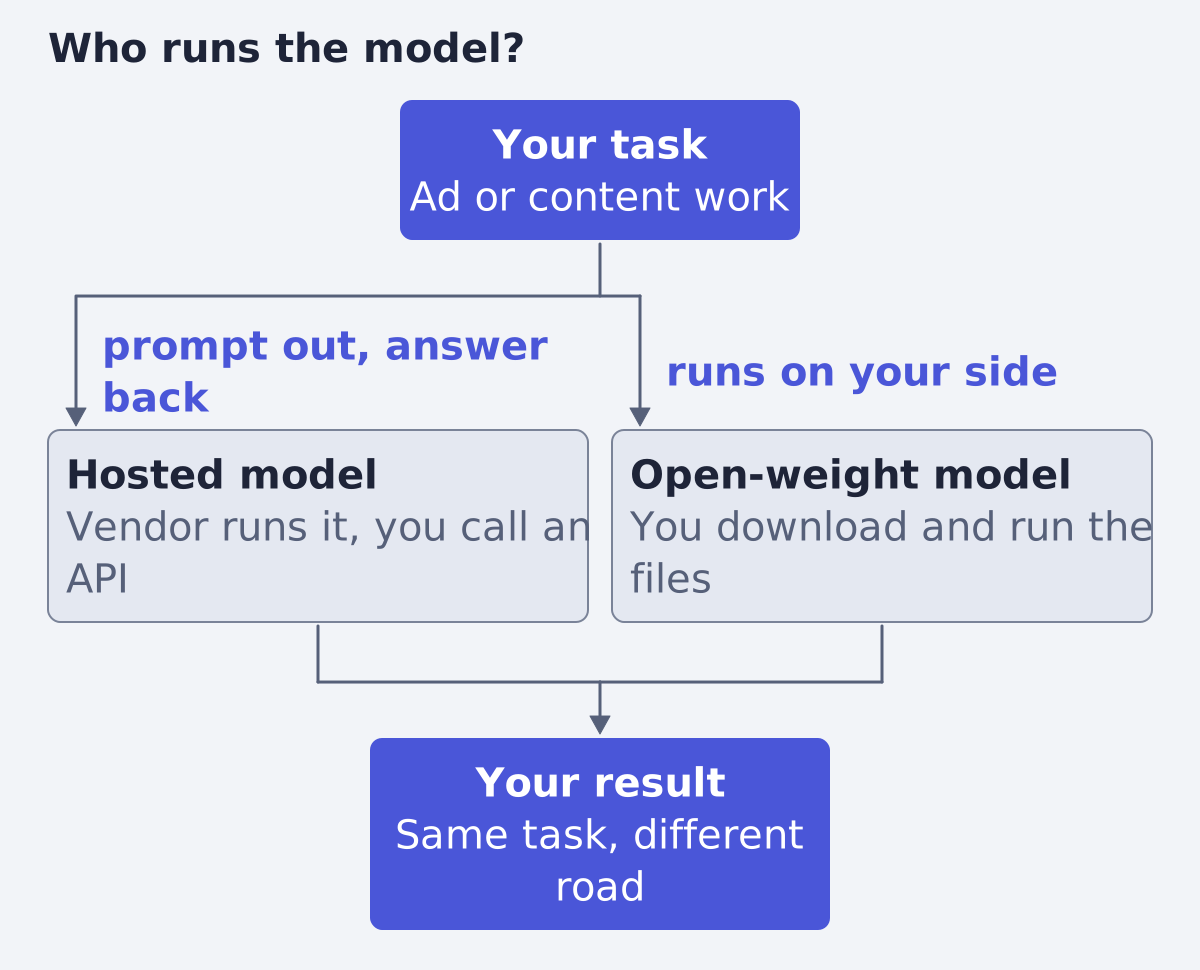
Neither Hugging Face's nor Anthropic's pages define the term "open-weight", so here is our reading: a model whose trained files (the weights) are published so that you can download them, run them where you choose and, if the license allows, adapt them. Hugging Face describes its Hub as "the reference AI platform for open ML", hosting over 3M models that are "all open and publicly available" (Hub docs). "Open" on that platform still comes with a license per model, which we come back to below.
Running such a file takes software. The Transformers library is described as "the model-definition framework" for text, vision, audio, video and multimodal models, "for both inference and training" (Transformers docs). The same page says that a model supported there works with many training frameworks, inference engines and adjacent libraries, and that over 1M Transformers checkpoints are on the Hub. In plain words: the tools exist and are shared, but somebody on your side has to use them.
What a hosted model is
A hosted model is the opposite arrangement. Anthropic describes Claude as "a family of state-of-the-art large language models developed by Anthropic", and you call it by a model ID through an API (Anthropic models overview). The vendor runs the model; you send a request and get text back. The same page gives each model's ID on Amazon Bedrock, Google Cloud and Microsoft Foundry as well; on most of them it is the same ID as on Anthropic's own API.
Two facts from that page matter to a buyer. Hosted models are priced per million tokens (a token is a small piece of text): for example $2 per million input tokens and $10 per million output tokens for Claude Sonnet 5.5 (models overview). And the vendor sets the lifecycle: the page gives a retirement commitment per model, such as "not sooner than September 28, 2027" for Claude Sonnet 5.5. Prices and dates change, so read the page, not this paragraph, before you plan.
Hosted versus open, side by side
| Question | Hosted model behind an API | Open-weight model |
|---|---|---|
| Who runs it | The vendor | You, or a company you hire to host it |
| Where your data goes | To the vendor's service. Amazon Bedrock offers regional endpoints with "guaranteed data routing" (models overview); read the vendor's terms for the rest | Stays on your machines if you run it yourself (our reading) |
| What you can change | The prompt and the settings the API offers | The model itself: you can fine-tune it, and the Hub marks fine-tunes, adapters and quantized versions with a base_model field (model cards) |
| What you need on your side | An API key and a developer to connect it | Hardware or a host, people who can deploy and update it, and a way to test it (our reading) |
| What you pay | Per token, as listed on the vendor's page | The pages we read state no figure; it depends on your hardware and use |
| The license question | The vendor's terms of service | The model's own license, shown on its model card |
The license field, in one line
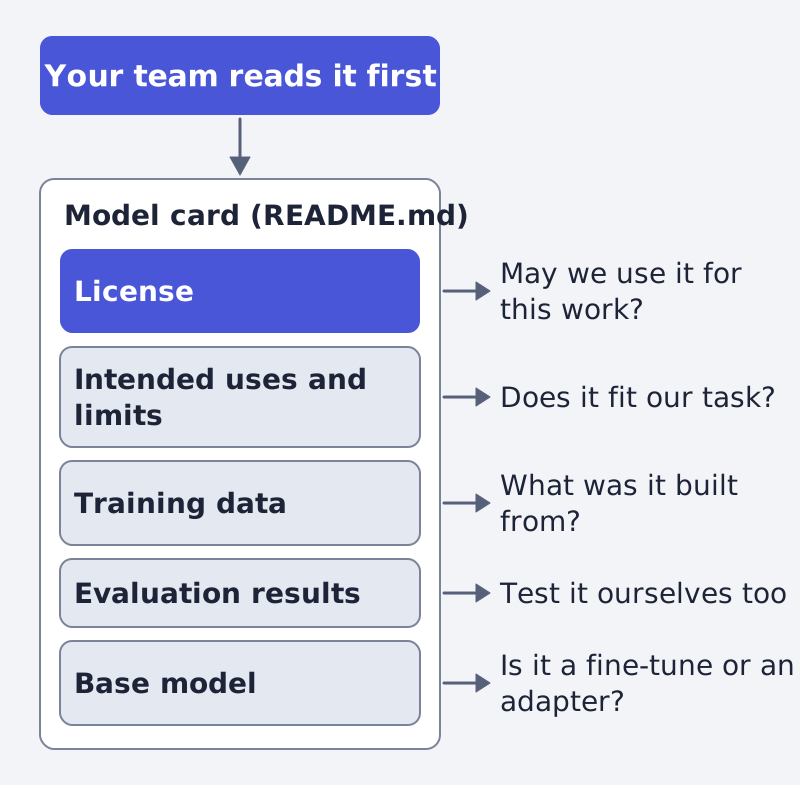
Each model on the Hub has a card, a README.md that should describe the model, its intended uses and limitations, its training data and its evaluation results, and whose metadata displays the license (model cards). The Hub lists the license identifiers it supports, from apache-2.0 and mit to named community licenses, plus other for a custom text, and asks you to "seek out and respect a project's license" (licenses). Some models are also gated: you must request access first (gated models). Your team reads the card before the model goes near client work.
When an open model pays off
These three cases are our reading of the differences above, not claims from the docs.
- Data that must stay in house. If a brief, a customer list or unreleased product details may not leave your systems, a model on your own servers keeps the prompt inside them.
- Steady, high volume. Hosted prices are per token, so cost follows use. If you run the same kind of job all day, every day, hosting your own can be cheaper than paying per request. Whether it is depends on your hardware and the real volume; we cannot give a break-even number, and no page we read does.
- One narrow task worth fine-tuning. The Transformers docs describe a
Trainerfor training and the Hub'sbase_modelfield records fine-tunes and adapters. A small model adapted to one job, such as sorting product titles into your own categories or rewriting descriptions in a fixed voice, can be enough. It is a project: you need examples, time and a test set.
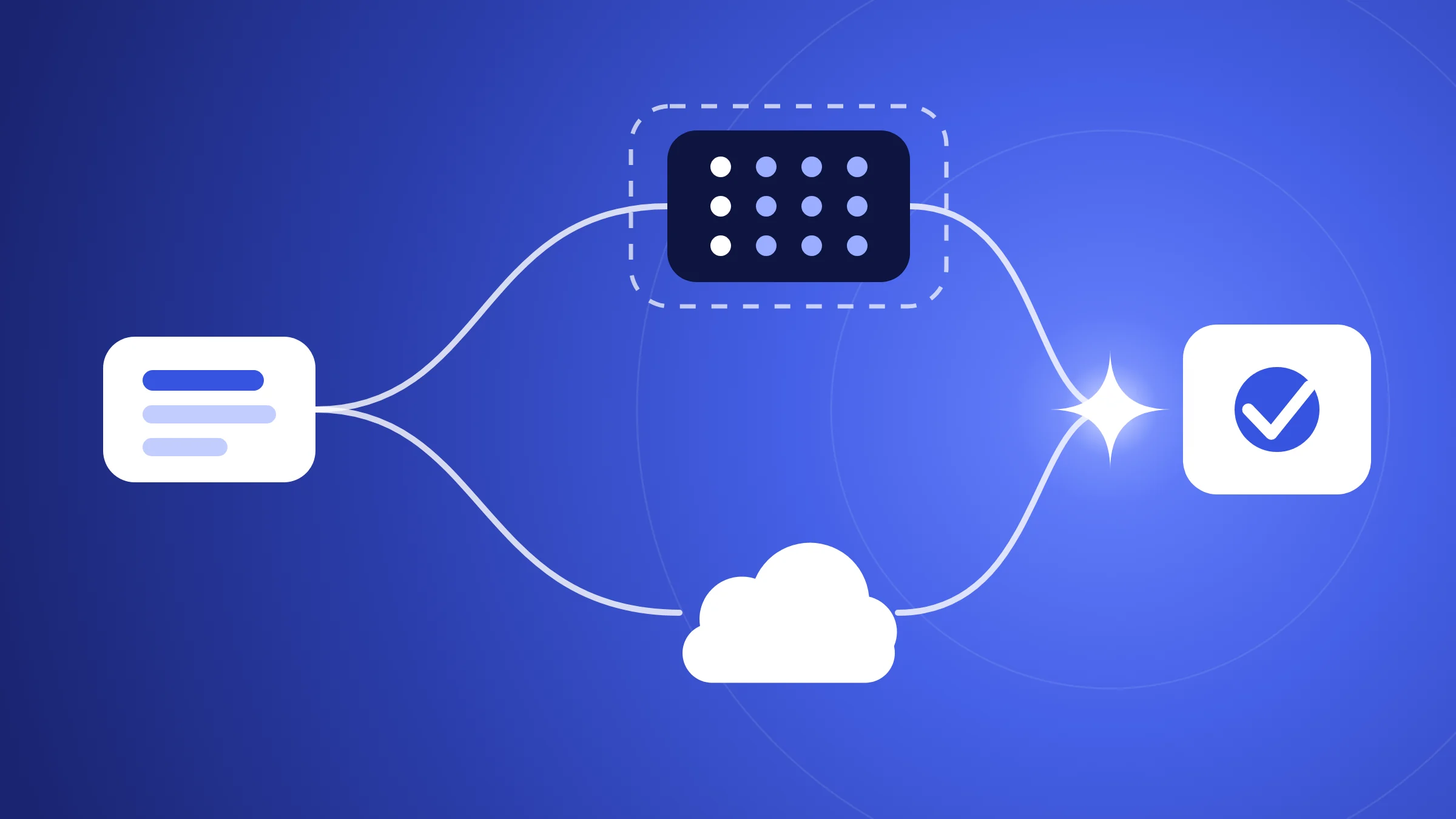
There is a middle road too. The Hub offers Inference Providers, "pay-as-you-go inference for thousands of models" (Inference Providers). You use an open model through an API without running servers, though then the data goes to that provider, not to your own machines (our reading).
When it does not
- No one to run it. Deploying, updating, monitoring and testing a model is engineering work. A team with no developer will spend its time on the model instead of the ads.
- The hardest reasoning. Anthropic's page recommends Claude Fable 5.1 "for demanding reasoning and long-horizon agentic work" (models overview). We found no page that compares open and hosted models on such tasks, so we make no claim about who wins. Test your own task on both before you decide.
- Low or uneven volume. Servers cost the same when idle. A few hundred requests a week rarely justifies them (our reading).
- A license that does not fit. Some licenses limit commercial use or carry conditions. Check the card.
A short decision flow
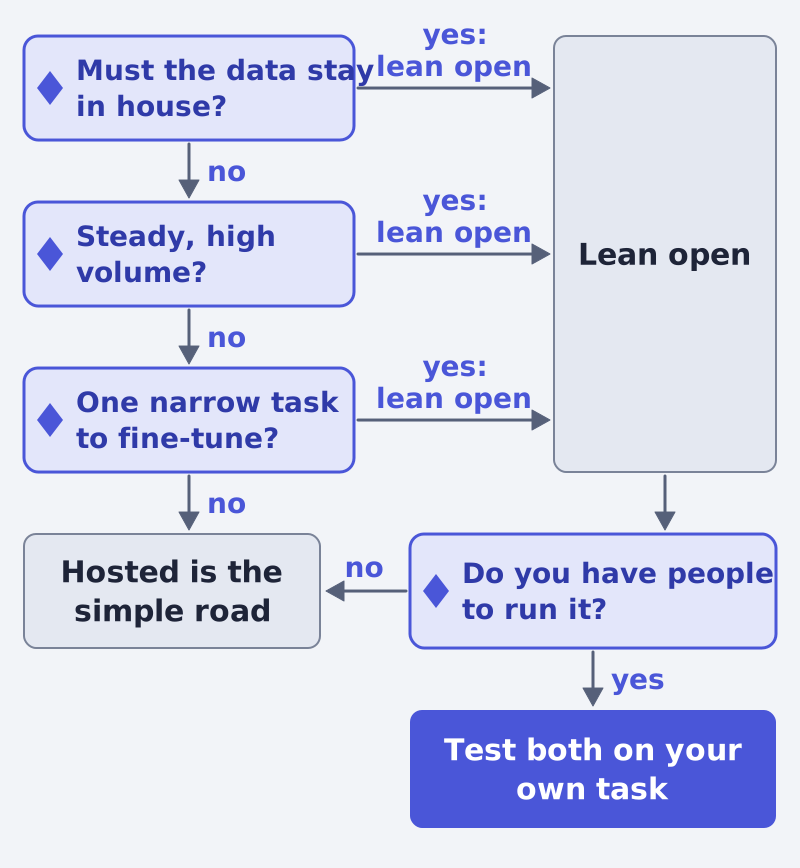
- Must the data stay inside your systems? If yes, lean open.
- Is the volume steady and high? If yes, lean open.
- Is there one narrow task you could fine-tune? If yes, lean open.
- Do you have people to run it? If no, choose hosted, whatever the first three said.
- If you have people and any of the first three, test an open model and a hosted one on a small sample of your own work, and compare.
Frequently asked questions
Is an open-weight model free? The files may be free to download, but running them is not: you need hardware or a host and people. Check the model card's license for what you may do with it (licenses).
Is an open model as good as a hosted one? The pages we read do not compare them, so we do not claim either. A model card should list the model's evaluation results; many do, so read them (model cards), then run your own test on your own task.
Where do I find open models? On the Hugging Face Hub, filtered by task, library or license through the metadata on each card (model cards).
Can a marketing team without developers use open models? Rarely on its own. A hosted model, or an open one through a provider, is the easier start.
Where this fits
Most marketing teams do not need to choose a model at all. If what you need is finished product ads built from your product feed, that is the work we do at Framepx, an AI system for product ads; here is how it works. If you do want to work with AI tools yourself, our guide to Claude Code for marketers is a gentler start, and what the makers' pages say about AI video models shows the same hosted-versus-open question on the video side. More guides are in the blog.
Sources
Written by
Framepx team, Editorial team
The Framepx editorial team writes for brands, marketers and agencies about ad platforms, measurement, creative and product feeds.